
Completely Inspired
From the Games I Have Played

Since last year (maybe the year before?) I have been running games again. I met some new people at an Adventurer’s League held in a store not far from my apartment, and when we had built a rapport, I invited them to join me in an exploration of the many games on offer. Though I have experience with games other than D&D, most of them did not.
Since I have been designing a game of my own, like many of you, I have spent the last few years attempting to branch out from my most influential sources to see how other games work. I explained this premise to them and they all seemed excited, if a little nervous, about trying something different. I assured them I would be shelling out for the systems and books, unless they also wanted to, and I would provide them with whatever rules and reference necessary.
Game 1-The Classic
My intent was to try different games, but first I wanted to play a RAW (rules-as-written) 5e game, using a set of official adventures to try and “feel” how the designers intended 5e to be played by way of their material. I had been playing 5e since it was released, but my group always added their own house rules and spin to the nature of the game, so I was trying to get the experience that most everyone else is led to have.
I grabbed one of the two adventure books I have ever paid for, Tales from the Yawning Portal, and set about my preparation. I did some online research of Oakhurst, because little was provided in the book, rolled up some NPCs, and even added some little bits of politics and drama for the PCs to discover in the village before setting off. I have a great love for maps and map-making, so I even printed off a 1” scale version of the dungeon maps, taping the pieces of paper together, so that we could spread them out and play on the grid. That was so much fun, I love maps!
The game was fairly short lived, as the PCs got surrounded and murdered about halfway into the first floor of the dungeon. We had hit some bumps on the road along the way already, but I wanted to continue and hoped that the experience wouldn’t be too terrible. I restocked the dungeon with some new denizens, having some outside elements come in and challenge the existing inhabitants, just to change the place up, and they engaged once again.
Another party wipe. They were doing well as they made it a little bit further, but some of the monsters escaped to grab reinforcements and the PCs just ignored this and were caught off-guard while searching the room. It was a slow and terrible slaughter.
The new party set out on some other published adventures I looked up, where I first started seeing what Arcane Library was up to, and shortly after the group had to be suspended because of two toxic players bullying another. Either way, the game was dead.
Game 2-Mutants & Masterminds
I had not initially been looking to play this game, the system is based on 5e (in my opinion it looks too similar), it’s a modern setting, and complexity is ramped up instead of down, which is what I was interested in exploring. One of my players suggested this when we reconvened, and I dropped the money and patiently awaited the books.
One thing I love about this game is the massive amount of options available to both the players and the GM. This many mechanical options is truly bewildering, but it is so amazing to be able to make any kind of character you want, or villain. This is also a huge drawback, as the character creation process takes forever and can be very confusing. I had players with some decent amount of experience with 5e, and they were having a rough time sorting through it.
One of the elements I cared for the least was the modern setting. I have never been a fan of playing in a version of the real world, or the real world itself, and this threw me completely off my game as the arbiter. I attempted to run the included adventure, and mustered as much excitement and engagement as I could, throwing everything at the process in the hopes of giving my players a fun time to stretch their powers while we visited this atmosphere.
One of the players really took to the game, so much so that they wanted to give me a break to run a fantasy version M&M. Being a Star Wars fan, I made myself a jedi with a light sword, force powers, the whole package. Being able to make that character and then play them really showed me the strength of this game, and helped me to understand the rules that I was struggling with as the arbiter. This player experience was extremely valuable, but it didn’t prevent us from moving on when his adventure ran its course.
Game 3-Mothership
At this point Mothership was blowing up across the online community (the little ones that I follow here and there). The rave reviews were in, the massive kickstarter completed, and I even saw a few plays on youtube. This game looked amazing to me. I love the Aliens movies, especially Alien and Aliens, and the idea of torturing my players in this kind of universe made me giggle.
As a collector, I bought the boxed set and dove in. Coming from 5e and M&M, the switch was drastic and difficult. Somewhere in there I had bought and read some segments of Old School Essentials, Knave 2e, Lamentations of the Flame Princess, Index Card RPG, Maze Rats, Worlds Without Number, Stars Without Number, Cities Without Number, and soon Ashes Without Number, Dungeon Crawl Classics, Dungeons & Dragons Rules Cyclopedia, Children of the Sun, The Witcher RPG, Black Void (still confused there), Dragonbane, Seventh Sea, Ars Magica, The Burning Wheel, and BREAK! All of that reading, not complete mind you, did not prepare me for the game I was about to play.
The design of Mothership is light, to say the least, and is vastly dependent upon the intelligence of the reader, the players and the arbiter. I was unaccustomed to this, and it was difficult. I was bound to run an adventure, of which there were several, and picked a little tri-fold pamphlet the Haunting of Ypsilon 14. This was the smallest adventure that I had ever seen, and the direction was vague and the possibilities endless (not really, but it felt that way). The layout of the character sheet was absolutely mind blowing and was a great reference for me when I was designing my Complete 5e Character Sheet.
The adventure was a bit of a rough start. Each player was terrified to lose their relatively weak character and the stakes were high. As soon as the first encounter with the monster came up though, they were excitedly tense and being as creative as possible to survive the situation. Exactly where the game, and I, wanted them. That first session was so impossibly amazing, and we knew that this game was going to be good.
The design of the rules leaves the players feeling like they are normal people, oppressed by the hyper-corps and left to fend for themselves in deadly situations. At the end of our run only one of the characters had made it through every adventure, and at the end we all realized that it was a game meant for short runs and not campaigns. The last adventure I ran was a larger one that came with the box, Another Bug Hunt. As we neared the end I saw a glaring problem, they weren’t going to make it. Yes this game is built for player choice during a horrible nightmare, but the climax seemed as though they couldn’t go on, even if they played well, and they adapted to and were playing very smart during this brief campaign. One of them even commented at some point about the seeming lack of danger in this latest adventure, to which I honestly replied that they were being smart and avoiding the danger or mitigating it with their choices, which was rewarded with relative safety.
As the adventure came to a close I learned something about these rules-light, deadly games that we were starting to wade into the seas of: if characters die too often, the sting is taken away. One of the players lost two characters in a single 3-hour session, and after that, the concept of them dying was starting to make the game stale. This fact alone was not enough to dull the shine, but adding the oppressive environment and the mind-boggling requirements for progression, I quickly lost heart as the arbiter. I, as well as the players, wanted their PCs who survived to make at least some progress. Stress was building, stats were starting to degrade, and they were nowhere near what they would need for shore leave to improve their stats and feel some gratification other than “we lived!”
#ROSTER
- Will Marine (player) Session 02 Blew himself up with the monster.
- Zeek Marine (player) Session 03 Interstellar Mega Mart "abyss"
- Edgardo Scientist (player) Session 03 Interstellar Mega Mart "abyss"
- Storm Marine (player) Session 07 Ambushed by carcs
In the last section of the adventure, I talked to the players and expressed my concerns. We all knew this was the game, but it didn’t really hit us until we were approaching the point where characters normally advance, even if just a little, that they were going to continue a dire struggle, over and over. This game is extremely fun, and I cannot recommend it highly enough, but without modification, at least for me it cannot be a campaign game.
Game 4-Shadowdark
When I told the players what we would be playing after Mothership, there was some excitement. Most of us have played fantasy games and to be honest, as much as I love scifi with bits of horror, most of my muscle memory is geared towards fantasy.
Shadowdark has been making the rounds in the community for a bit now, so I don’t think it needs much introduction. Like many others, I was absolutely fascinated and intrigued by the inspirations and the overall choices made in its design. As soon as I started reading it, I knew I wanted to dive in.
My first impressions of this game are quite fond. The layout is excellent. I will speak more to this later but throughout Mothership I was having some serious trouble finding rules. I would remember the rule I wanted to reference but I could not find it when I needed to. This isn’t a huge deal, I don’t have a problem making a call in the moment, but if there is a specific rule I like to at least see it before I make a decision. After years of playing games where each base rule is important, because other rules build from and break those rules, I would get lost frequently trying to find something.
The foundation is a mix of 5e and original, taking the best of both and leaving the rest of the complexity on the cutting room floor. This fact alone gave me such a breath of fresh air. I was familiar with the rules already, the style was definitely inspiring, and I didn’t have blocks of text all over the place to cover every little detail of an outlier situation. For most rules light games I scoff at the lack of clarifying even the most basic of rules, which leads to everyone creating everything on the spot and the arbiter having little idea where the bounds of the box are. This is a problem I have discussed before so I won’t go on too much, but I found Shadowdark has just the right balance of foundational rules and those that bend, break, or add to them.
The “plain English,” or the straightforwardness, of the rules also caught me off guard, and took some time to adjust to. But I love it. That little sentence describes it in just as much detail as is truly necessary, not any more, and not any less. After perusing all those other games, and then playing Mothership, Shadowdark really hammered home the point that thick blocks of text are difficult and often overused. I am a fully capable reader; I read for recreation, I write (obviously), and I have been designing material for games for over two decades now (sigh). When I began looking at my Alchemy system to update it and apply much of this new knowledge, I found myself lost in my own text blocks. The organization and stylistic approach was greatly inspired by the already complex game I was stapling it to and that was a bad thing, not a good thing.
Shadowdark has found a balance with detail in rules and vagueness in fiction that shows us, the readers and players, how something works while boosting our creative minds on how it looks or feels. While reading through the rules, both the core and the first Zine I was planning to run, I regularly came across little bits of inspiration that let me know what I needed while creating imagery in my mind. Some rules just aren’t present, and I need to decide how I am going to handle those situations, but that’s okay, because they are outliers that will depend on the circumstances. The character abilities, the monsters, the spells, all of them cover what is necessary, which is an area I find other rules light games struggling with.
Now that we are a few games in, I am so excited to run this game, and it has inspired me, completely.
My Inspiration
All the version of D&D I have read or used in all my years of play are heavy in their mechanical design. Over the years as a player I have enjoyed digging through those complexities to find interesting characters, and as a designer I appreciated the amount of investment and understanding needed to bring new rules to bear on the system. What I did not realize though, is that they were building a set of weights up that I had to hold while navigating them. When I read, and then began to run, Shadowdark, I felt this weight begin to fall off of me. It is a strange sensation.
I have written about my problems with the rules light games of the modern hobby space. These are my opinions, and I do not fault or attack anyone engaging with them at all. When I speak about the delicate balance a rules light game needs, what I didn’t know before is that Shadowdark has found that balance. The foundation is strong, the incentives clear, and the excitement it gives to both player and GM is contagious.
As I was fleshing out the details for my run of the first Shadowdark Zine, I realized that I truly loved this expression of our hobby. This style is what I have been looking for, even though I didn’t know it. I knew immediately what I wanted to do.
Shadow Alchemy
Since I have been reworking my Alchemy system lately anyways, and I realized I needed to go less crunch for even me to want to engage with it, I figured I could go even lighter and make a supplement for Shadowdark. A light version would be simple, approachable, and adaptable by the players and the GM for whatever style of game they wanted to play in the lethal fantasy world presented. Going out into the wilderness is already the theme of the game, why not give the PCs another way to prepare for their endeavors, and possibly have another random encounter.
The New Challenge
For years I have been absolutely interested in making systems as complex as possible to give the crunch that makes investing worthwhile. I like to invest time in learning the rules of any game I play in, and I feel that is how to be respectful of the GM. As I mentioned earlier, this is to my own detriment. Given the simple nature of Shadowdark, my new challenge would be to design a system that is easy to engage with and does not get in the way. I am wholly excited by this, because I am designing for function and speed, not accuracy or verisimilitude, whatever those mean when it comes to adult make-believe.
I had already started down a path of simplifying my alchemy system, altering the properties from fully detailed entries that would contain all sorts of information that the player would need to craft even the simplest of potions. I have now replaced each entry with adjectives in bold throughout the description of the concoction recipes, or formulae. A healing potion does healing, so ingredients that have healing properties can be used to create a healing potion.
Healing Draft, Ingested, 50-250 gp
You regain hit points according to the variety of this healing concoction. Whatever its potency, the potion’s red liquid glimmers when agitated.
Potion of … | Rarity | HP Regained | Cost
Healing | Common | 2d4 + 2 | 50 gp
Greater healing | Uncommon | 4d4 + 4 | 100 gp
Superior healing | Rare | 8d4 + 8 | 200 gp
Supreme healing | Very rare | 10d4 + 20 | 250 gp
The ingredient description will also be pared down accordingly, where an oak leaf simply has words beside it that are its properties. There will still need to be some paperwork in tracking all the ingredients you have obtained, but an alchemy system was always going to include a little more tracking than a normal character.
BLACKWOOD
Familiar, Tree, any
Blackwood acacia, black wattle, (acacia melanoxylon)
Bit | Property | Bit | Property
Bark | Protecting | Sap | Sensing (psionics)
Leaf | Loving | Seed | Fortune
Root | Whisper | Wood | Incense, Str 7
Application. Incense, smoking. The seeds of blackwood can be ground into flour and the timber is used for everything from implements and tools to weapons and instruments, incense, fuel, and furniture.
The sapwood of the blackwood trees range in color from that of straw to gray-white with a clear heartwood demarcation. It has no flowers and the trees grow quickly, with needle-like, plump, green leaves.
Blackwood trees are associated with protection from prying minds and entities, psychic powers, money, love, and spells.
Just the Alchemy System?
Why would I just create a small and simple alchemy system to go with this new game, when I can create a bit more? Well, I immediately thought about making my own version of a Zine to introduce the idea of the alchemist, these new rules, and some adventures that might focus somewhat on it. I did a lot of work years ago to make a fantasy-horror adventure for my friends; I drew the maps, marked and detailed the locations and sections of the dungeons, and filled my starting town with intriguing hooks for both the dungeon and some political adventures going on at the same time. I never fully finished it, but I did get a lot of it fleshed out.

The Shadow Alchemy Zine
So, in the spirit of the Zine that pushed my inspiration from moderate to complete, I would create my own. I have an adventure, some new race and class ideas, and a simple alchemy system that will fit in with the rest of the Shadowdark rules light system.
The Adventure
The adventure takes place in my primary town of Dadeboro. I call it that because for many years, I have used versions of this town as my starting place for any games I have run. Though I have changed worlds and histories and setting themes many times over (the curse of the GM), Dadeboro has largely stayed the same. Luckily I still have my original maps and some of my notes, though the rest has to go off memory as I lost my setting notes in a failed backup experiment on my last PC.
A dwindling guild of mages has been experimenting with dark powers that are not out of control and corrupting the land the people, but mostly the people. There is a growing threat from these aberrations, a vengeful necromancer just outside the town, and a corrupt ruler leading the people into danger for riches. These three primary events continue as the PCs engage whichever suits their fancy, and maybe a few more smaller events are on offer to bring the world to life around them.
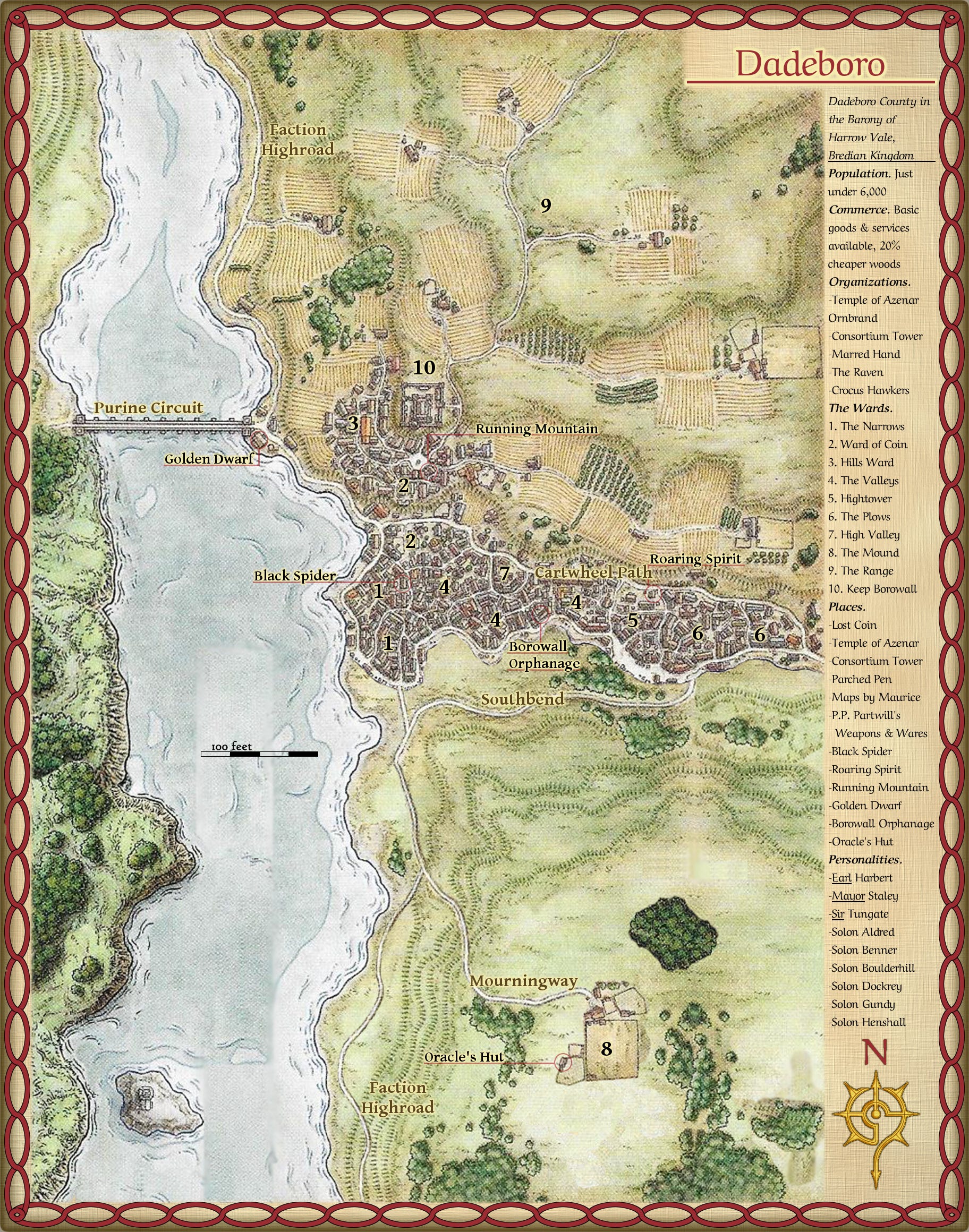
This map is made from pieces of published maps, it is not my original work, and it is not for sale or production or anything else, it is just to show what I created. Yes there are flourishes I added, but my skill level is nowhere near professional, so please don’t copy or distribute this.
The Ancestries
The halfling has always been my favorite race from D&D. Since my first characters in this game, the halfling thief, or rogue, has been my go-to. When I want to play a character that I am absolutely comfortable with and can engage in deep roleplay even while sleep deprived or shaking from caffeine, I play a short ne’er-do-well.
One of my favorite series of books was the Wheel of Time. It took me some years to complete, and the story and rich world had me from the beginning. A favorite character is of course Loial, the gentle giant who always has a book in hand and nary a negative word for his beloved companions. This character got me thinking about having a large playable race, since the average size was covered and there were even a few small options. When I set down and created my final world, I made sure to include a form of giant as a species.
Jotning (Giants)
Giants are peaceful folk that take joy in stories, crafts, and exploration, and are the most gifted cartographers in the worlds.
To be an explorer, artist, or craftsmen of any kind requires focus and patience, perseverance in the toughest of times. Giants have those gifts, but not when it comes to other people, even other giants. Their size makes them slow to speak, and they are often outspoken by the smaller races or considered dull-witted, and treated accordingly. This kind of attitude will anger a giant faster than anything else, forcing them to show a legendary temper. Most other actions, insults, or hostilities will simply put the mild-mannered giant on the defensive, giving their adversary time to calm down and explain the problem while dodging or backing over furniture.
Divinity in Everything
The largest people of all the races are deeply spiritual, seeing gods, ghosts, and entities within everything. Giants are animists, and are deeply in tune with their faith. As the giants explore, they offer prayers and sacrifices to the spirits of the roads, plains, or forests, and when they rest they venerate those of their homes, those controlling the weather, and the Fates, their most important spirits.
They do not deny or even ignore the gods, they are included in their respects, and some even learn a great deal about them to better include them with the spirits.
Venerated Craftsmen
Giants are the most gifted builders of all the races, and their handiwork can be seen all across the lands. The greatest and most important structures in the regions of the other races were most likely built by giants, and many have stood for several ages. Many of the ruins, especially those found in the recently abandoned elven lands, are still standing and able to be explored because of their giant craftsmen.
Giants are also gifted artists, and are especially good with paints and cartography. Many giants have tried their hand at writing, but they can never seem to tell a story themselves, but they are excellent at documenting the tales of others.
Fork in the Road
Just as they are slow to speak and move, they are slow to leave their homes. The tall ones love their comforts and amenities, to be able to work their gardens, prepare a nice meal, and then kick back in a lounge chair with a large book and a full pipe. For some, this is enough.
For others, the open road and the energy of shorter fellows beckons them out into the world. Most giants know a great deal about what to expect outside their borders before they ever leave, the information stored in the gigantic libraries is renown throughout the world, and their children are well educated, often speaking and writing four or more languages.
If a giant is to leave home, they and their family know by the time they reach their 25th year, when they are considered a giant (adult), and can choose to stay and learn a profession or leave for the excitement and glory. Journals with quill and ink as well as barren maps are the most common gifts on this day.
Checkered Past
The giants of today were not always so peaceful and slow to act. Tales and legends speak of an age when they were conquerors, having taken most of the world and built the most amazing towers, citadels, and keeps anyone could dream of. The walls were said to emanate magic and empower long-forgotten giant spellcasters to defend one castle against a horde of darklings. In the modern world these are not a lot of giants that wield magic as the smaller races do, but those that are spellcasters are said to be frighteningly powerful, mysterious, and as dangerous as dragons.
Jotning Names
Male Names. Eamadin, Elur, Jandrim, Januth, Lestoth, Olvam, Osod, Padrea, Therran, Zorris
Female Names. Amyana, Brinyth, Eloane, Filith, Gilyna, Loraile, Melerava, Selora, Selush, Tyena
Surnames. A’valda, Bashind, Cineos, Dagara, Damamon, Gamyl, Hariaw, Jeloihan, Kashys, Kiralda, Lameran, Lanin, Matherin, Meland, Naerineos, Piros, Saled, Stepag, Tiaya, Velear
Jotning Traits
Giants are a lumbering race, who can move switfly when necessary, but normally have a slow gait. They have large noses and their ears are also large and somewhat droopy, their lobes hanging up to several inches.
Ability Score Increase. Your Wisdom score increases by 2 and your Strength score increases by 1.
Age. Giants can live to be up to 300 years old, 350 if the Fates will it. They mature around their 25th year, when they choose to stay at home and leave for adventure.
Alignment. Giants are a peaceful people, with a great amount of patience and tolerance for the antics of the smaller races. They pay little heed to the laws of other races, as they see little use for them, but they are not outwardly chaotic. A giant can be drawn to action with even the slightest hint of suffering or ill being applied, leaning them heavily in the direction of good.
Size. Giants stand between 7 and 8 feet tall, weighing around 300 pounds. Your size is Medium.
Great Stature. Though you are Medium size, you count as a Large creature when determining your carrying capacity, your push, drag, and lift weight capacities.
Even though they are large, giants are primarily mellow and lackadaisical, requiring 10 hours of sleep for a full nights rest.
Large Hands. One-handed weapons count as light weapons while you are wielding them. When you wield versatile weapons in one hand, you use the damage for two-handed use.
Keen Smell. Whenever you make an ability check related to concoctions, potions, plants, or alchemical items, you can add twice your proficiency bonus, instead of any proficiency bonus you normally apply.
Speed. Though you are much larger than most races, your lumbering gait keeps you apace with them. Your base walking speed is 30 feet.
Momentum. When you take your action to dash, you can move an additional 30 feet.
Avid Readers. A giants most favored pastime is to read, giving them amazing memory and a gift with puzzles. You can accurately recall anything you have read, heard, or learned within the last month. Also, you have advantage on all ability checks when dealing with puzzles.
Languages. You can read, speak, and write Common, Juoteen, and two other languages of your choice. Juoteen is a language long-descended from the old giant tongue, but so far removed with the influence of their educational pursuits that they are extremely difficult to compare.
Another of the species I wanted to include was a kind of satyr. Nothing says fantasy to me like the classic fairy tale creature with a scant loin cloth and a lute. I also found some amazing art on pinterest at the time that really got my mind going, and I created a race of fey descendants that took on more of the animal side without being too “cartoon-y.”
All of my species are detailed for 5e, and if you want to see more of their statistics just let me know. This post was already too long for email, so I figured I would only include the one race and its characteristics.
During all of my years engaging with fantasy and scifi, the concept of immortality, or at the least massive lifespans, led me to think of the elves as more of a sinister people. Living for so long, in every other fiction we have, leads entities to become jaded to life and lacking empathy for anything that isn’t them. Vampires, AI, deities, all of these long-lived entities end up with the attitude of a child with a magnifying glass, and everyone else is an ant, so I made the elven society one of the villains of the world. This helped with implementing the satyr like peoples to replace them.
Another race I loved from older D&D was the warforged. The way they brought them into the world of playable species I absolutely loved. Their backstory, their themes, and even their rules were a really new and interesting way to have a sort of living automaton, a golem with a soul, and without being too powerful or unbalanced. So I made my own, and tied them directly into the history of my world. The illun are a people of artificial magical consciousness that found their way into servitor bodies in the ruins of the ancient utopia. Upon integration their memory was essentially reset, and all they know is they woke up in the bowels of the world and slowly made their way out into civilization.
The Classes
Of course there is going to be an alchemist class. I have had notes sitting for a long time in my folders, and most of them never even made it to my old digital files that I eventually lost. I wanted to make the class with my first iteration of the alchemy system, but the rules were too complex to have a class relying on them for their power.
This gets into my exploration of the class design in 5e, where I discovered that each class needs to rely on themselves as their source of power. Each of them may have a specific tool or weapon they use, but ultimately their power comes from within, and thus cannot be taken or withheld and the character dis-empowered. When I realized the class would be relying on their gathering skills to obtain their power, or at least having to interact with them more heavily than any class does with external rules, I decided to scrap it until I could solve this problem and retain the theme of the class.
But with Shadowdark, the class design is much simpler and has a greater opportunity for new rules, so long as they too are simple and keep the balance of strong foundational rules and ease of play.
My first thoughts have the alchemist preparing their potions each morning before adventure, much like spellcasters prepare their spells, and as they use their potions they roll a usage die to determine if they have used up their stock for the day. As they grow in power these usage die increase in size, and they have a bonus to interact with the alchemy system outside of their class, allowing them to create limited number of more powerful potions for the rest of their party to use. Once again, the challenge is to create a class that is simple and easy to approach, but has a feel and application that is unique and stands out as different from the other options.
Potions. When you use a potion, roll your familiarity die. Rolling equal to or below the number of potions you’ve used today decreases the die size. All famillairity dice reset each day.
Another class I would love to introduce, especially where the main story is about summoning gone wrong, is a summoner. I have always loved the idea of a summoner class, but I have yet to find an implementation that is satisfying. Much like the artificer in 5e, it says alchemist but screams I too have spells. My initial thoughts give the class three different entities to summon, and once summoned, they can only concentrate on controlling it. This would mean their attacks, defense, and utility would all stem from whatever they summoned, the power of their class. I have thought less about this class than the alchemist, but I am definitely going to be pursuing it.
Lessons Learned
My exploration of different games has definitely given me a lot to think about. My head is always in a state of flux anyways, I have been a regular viewer of several P&PRPG advice channels on youtube for years, and I have been reading a lot more about the hobby recently. But as I was going on about the different games I have played since I re-entered this hobby, I was reminded of some valuable lessons I have learned, hopefully.
Give the Players the Information
The difference between the players and their characters is not their supernatural abilities, massive amounts of health, or their progression from nobody to god in under a year; it is their ability to perceive the world. Players, as people, have available to them all of their senses all the time. We do not need to explain the world around them unless something truly strange or bizarre is in action, which is extremely rare. The characters however, they only know about what we tell them they know as the arbiter.
People can only make informed choices, whether good or bad, if they have the relevant information. I am ashamed that it took me so long to come to this realization, especially after having encountered it so many times across videos and advice columns, but when I was running Mothership this became pointedly obvious as the players asked so many more questions because they were in a state of horrific tension (they clarified it was the fun state of fear that comes from a good game or movie). As we moved into Shadowdark, I became even more painfully aware that I need to give them all of the information, and then some, to even hope that they will make smart decisions, or at least decisions that are reasonable given what they know and where they are.
Be Clear About Mistakes & Corrections
Playing so many games of late has led to many mistakes on my part. During our first game of Mothership I completely forgot about the stress rules and almost none of the characters gained any stress or had to make any Panic checks. This really dulled the game and made everyone wary, but as soon as I realized this and corrected it in the next session, we had a tension-filled blast! The stress mechanic is central to the Mothership experience, and without it the players were feeling a little dull.
I also got caught up in the action at one point, taking a lead from the adventure and acting against both the situation the players created and my own sense, and made a moderate mistake. After I calmed down after the game, got some food in me, and was doing my After Action Report (another excellent advent from this game), I realized my mistake. I figured out what went wrong and took to discord to admit my fault and correct the situation before our next session. The players took it in good stride and when we picked up they were pleased they now had a better chance of dealing with the situation.
Layout is Super Important
As much as I love Mothership, the layout became a huge problem for me. As a rules light game, those rules that are there are tightly connected and I don’t like missing them. I am completely confident in my ability to make a ruling, that is not the issue, especially since I include my players when I am making a ruling; “this is what I take this to mean, how does that sound to you?” What I am talking about is the ability to find something that is relevant to the moment in a small booklet with small rules littered throughout. The thing I immediately fixed with a sticky note was the lack of a contents page.
When a game is small in scope, and there are few rules, those rules interact with and rely on one another much more strongly than in games with a larger spread of rules. If the standard rule is that all characters move slowly, and certain class traits allow them to move quickly, then this foundation is set and the class allows the breaking of that rule. This is a specific interaction between a foundation, or core, rule, and the superseding specific rule. Throughout Mothership there are little interactions like this and several times I could not find them, which sometimes meant a player may have missed something they normally wouldn’t have, all because I couldn’t find it.
Text Blocks Are Bad
This is not a blanket rule or an industry-wide observation; not all text blocks are bad, per say. From my recent experiences, I have played a few games that have decidedly less large blocks of text, and one that had more massive blocks of text. For years I took this as the standard, yes I know, and my design followed those examples despite my confusion at not using plain text. This became especially apparent to me when I started looking at my alchemy system to see what needed to change, be added, or even cut, in order to move it into the next version. The chunks of text were difficult to parse, tightly packed headings hard to locate, and over-explained edge cases filled the mind with too many variables. I wasn’t relying on the intelligence of the reader, and instead was assuming that I would need to lead them by the hand through everything.
The most recent game I have been reading through, that I haven’t been playing that is, is BREAK! the RPG. And this one, I have been going cover to cover. There are several good videos by more experienced reviewers out there, so I won’t go into too much detail, but wow.
This game has amazing layout, excellent text density, great use of color and symbols, and easy to parse vocabulary. The setting is not something that appeals to me, I have never been a fan of anime, but the rules and fiction are simply astounding, and they feel quite fresh in a hobby that has lots of trends. Needless to say this other game has been giving me a lot to think about when it comes to designing, and laying out, an RPG.
Conclusion
Wow, this was another long one. Thanks for sticking around. If you are interested in following my journey through game design, as well as the different games I am playing along the way, you know what to do. If you feel like supporting me, and getting something interesting as well, you can have a look at my humble offerings on itch. Otherwise, I hope you see my words again soon, probably next week.
Indeed a lengthy read, but I enjoyed your analysis of various games. What you liked and what you didn't like. It is inspiring.