
Heartbreaker Part 2
Electric Boogaloo, or Weapon Forms

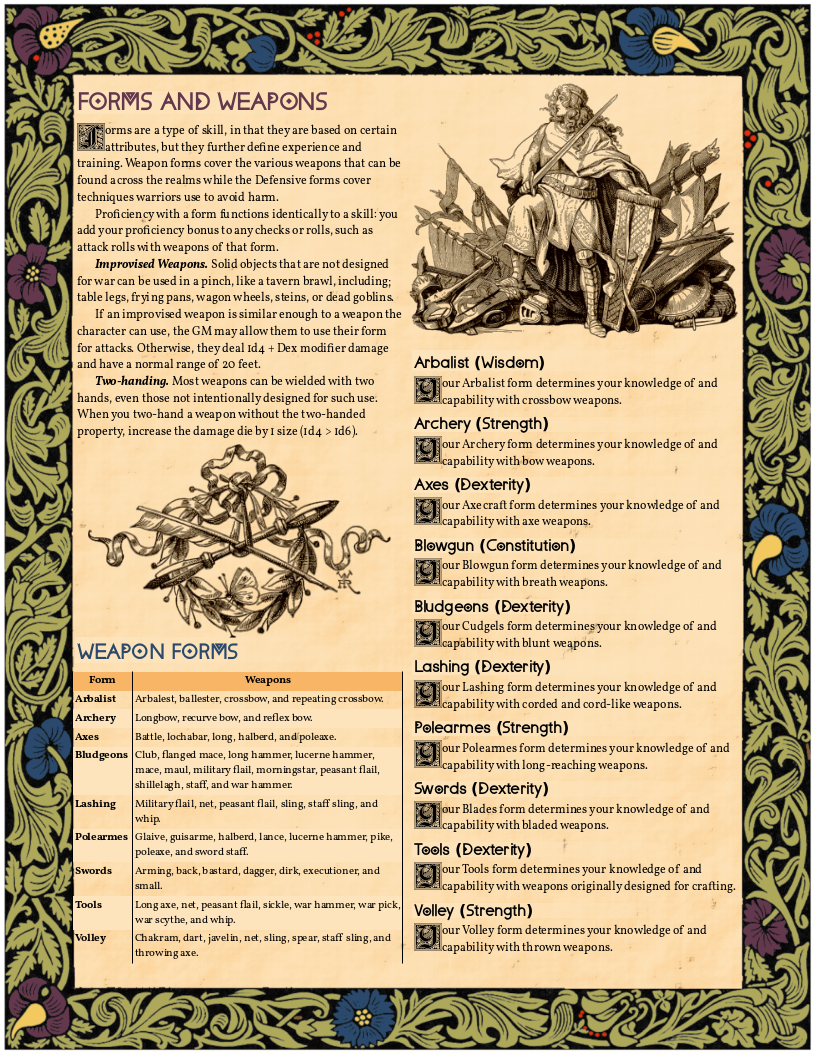
My last Heartbreaker article ended with a sneak peak, a reference to how skills are calculated and used. In my latest supplement, Weapon Forms, I have created a whole new set of skills called, wait for it, Forms. Forms, or Weapon Forms, cover the whole gamut of available weapons that characters can use, calculating their bonus as you would a skill, rather than a more difficult system including two separate, and large, groups of weapons with little exceptions here and there.
Starting Point
In the 3rd and 3.5 editions of D&D classes had a Base Attack Bonus, what would later become Proficiency Bonus is 5e. They both function nearly the same, with the BAB covering only attacks while the PB also covers skills. In 3rd and 3.5 skills were a totally separate system where you could dump piles of points into the skills you wanted, there were distinctions between trained and untrained, and there were a load of other miscellaneous bonuses you also had to account for.
In this latest edition, expanding the PB to include skills and other summations, such as spellcasting attack bonuses and spell DCs was smart, efficient, and made much of the game simpler and easier to grasp. If you were proficient, with anything, simply add that bonus and the relevant ability modifier. When it comes to design, this is a streamlined beauty that would of course come from experts in their field.
Weapon Groupings
My first issue was with the groupings. No it is not a big deal, and no I am not going to berate anyone for them, I simply disagree and have wanted to alter them. Training with any sword would naturally lend more skill to using any other type of sword, but it does not grant more skill with a club or a shortbow. Handheld weapons are more similar to one another than one is to a ranged weapon, obviously, but having all these lower damage weapons together made little sense, save for efficiency.
If the designers had left it there it would not be so bad, but they didn’t. By giving many classes their own little selection of specific weapons, rather than either simple or martial, they were creating smaller groupings already. So why not just group them logically since you went that far; swords, axes, bows, etc.?
Proficiency
This little problem didn’t really creep into the fore until I was making my Complete Character Sheet (available for only $2!). As I was sorting all of the different boxes and sections for numbers and markings to go, I made spaces for Simple and Martial weapon bonuses beneath both the Strength and Dexterity columns, given all the mundane weapons use one of those abilities. Each column had a space for all the pertinent offensive ability information, so those boxes, along with melee and ranged weapon proficiencies, went well together. It seemed fine.
For the last year or so I have been playtesting my sheet, as well as handing it to anyone around me that needs or wants a sheet (these are the only ones I carry so in the case no one else has a regular sheet I can hand them one of mine). Every time I filled out that section I seemed to be mixing which bonus I was using across the sections. It is not a big deal, but it is an inefficiency that regularly caught on my mind. I eventually just went back to including the attack modifiers in the weapon description section, as I kept confusing myself, which is really bad given that I designed the sheet.
Class Focus
This is the big issue I was seeing that I wanted to address. A fighter specializes in combat, the section of the book that is used most often with this game, is basically the fighter’s section. The fighter, despite their focus, has about as good of a chance to hit as any other combat-adjacent character, because the weapon groupings are so broad, and because proficiency with all the weapons is so open. On the average, fighter characters will have slightly higher combat stats, strength, dexterity, and constitution, but that is not always the case.
When you are playing a fighter, you should be hitting far more often than anyone else. The statistics for your class do not give you this ability though. Every class has some proficiency with weapons, and given the focus of combat in the game, every character is built for mundane combat first, and then their specialty is placed on top. Fighters are a bit better than everyone else, but the difference is negligible, in my opinion.
Time and time again I have watched as clerics, not battle focused mind you, waltz into the fray and show up the fighter. Unfortunately, rangers were never a threat here given the poor design in this latest edition, and of course barbarians also tend to outshine them as well. Rogues can also outshine the fighter, something I have done several times, despite having less attacks and all around weaker weapons.
Addressing these Issues
The mechanics of proficiency with skills and with weapons and with anything else is all the same, all of it. The only difference is how those systems are described in the rules. And don’t get me started on the “verbosity” of the rules in some of these books…
The bonus you add to rolls using a skill you are proficient with is as follows:
Proficiency Bonus + Ability Modifier.
The bonus you add to rolls using a weapon you are proficient with is as follows:
Proficiency Bonus + Ability Modifier.
The bonus you add to rolls using a saving throw you are proficient with is as follows:
Proficiency Bonus + Ability Modifier.
The bonus you add to rolls using a spell you are casting is as follows:
Proficiency Bonus + Ability Modifier.
The bonus you add to rolls using a tool, instrument, or vehicle you are proficient with is as follows:
Proficiency Bonus + Ability Modifier.
I am starting to see a pattern here. The only problem with this pattern is that while it is the same, it is not described to the player as being the same. Once again I see what they were doing, and I do not fault them for it. 5e, at its core, is about the three different types of rolls; the attack roll, the ability check, and the saving throw. Ability checks deal with skills and applications of abilities that do not fall under any of the skills. Attack rolls deal directly with efficacy in combat, melee and ranged attacks as well as spells and magical abilities. And saving throws, well, they are reactions you get for free to avoid harms.
Sidenote
Recently I was looking into the saving throws, as I was starting to wonder how many times a wizard would use their Intelligence save. I haven’t played a wizard in a while and I realized when I was making one that I cannot remember the last time I saw anyone, or heard of anyone, actually having to make an Intelligence saving throw. I have also been catching up on Critical Role, because I wasn’t able to keep up with it all those years ago when I first found it. I looked through all of the core books and found only 3 effects or spells that called for an Intelligence saving throw! I was mad, because all those wizards were basically running around the various worlds with half as many viable save proficiencies as any other character.
Defense Forms
When I was creating the layered armour system and the skills for the weapons, I also started taking a closer look at things like shields and other methods or techniques for defending oneself. A cool new rule I saw in the Level Up Adventurers Guide was the ability to sacrifice a shield to negate a critical hit. This option doesn’t negate the hit completely, it just turns a critical into a normal hit, but it breaks your shield in the process. This got me thinking.
Using a shield is more in line with strength than dexterity; shields are heavy and difficult to maneuver, so why not create another type of Form that allows strong characters to use their Strength in defending themselves with a shield? Then I also though about Parrying, which is a dexterity thing, as well as dodging, which is a wisdom thing (you need to see the thing in time to know which way to throw yourself). Thus, the Defense Forms were also created.
Weapon Forms
I regrouped the weapons, put their rules in line with the skill rules, while still distinguishing them as separate, and I allowed characters like fighters to be able to better focus on what they do best. Creating weapon skills, essentially, opens up the already known mechanic of expertise, which a fighter could use at 1st level in one of their Weapon Forms, allowing them to double their proficiency bonus with their favorite weapons. Yes, this will upset some balance (like CR was ever balanced to begin with), but it will also make that class shine again! A fighter will now hit far more often than any other class, just as they should, and it is only using existing mechanics from the skills section to do it!
Showing the Player
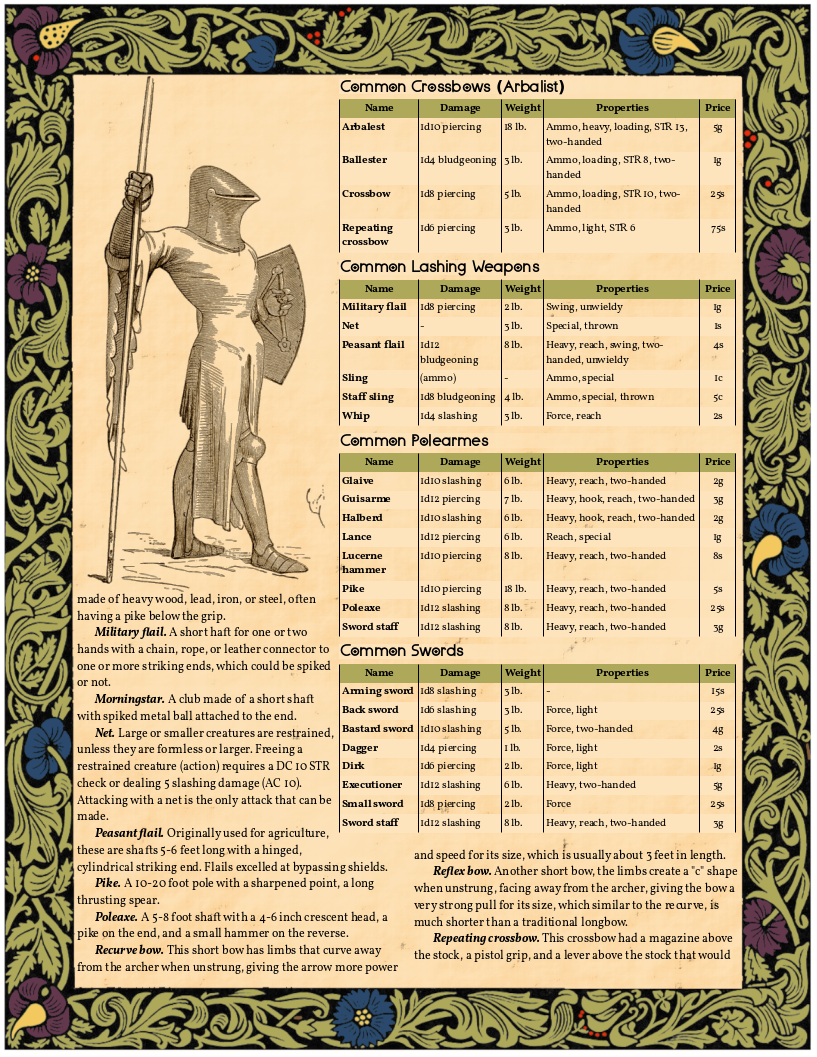
I think I mentioned this elsewhere, but it is worth mentioning again. If I was just adding a few new skills and ‘medievaling’ the existing weapons and armour, I may have only needed a few pages in my supplements to do that. What I also wanted to do was fix what I think is a critical error in the layout of the 3 core rulebooks: all the cool stuff is in the GM’s guide.
As part of my supplements I went through all the SRD and pulled every magic item for both the armour and weapons to add them into the lists. One of the greatest sins is keeping all the cool magic items out of the eyes of the players. I am of the opinion that all the cool stuff should be front and center for the players, after all, it is with all the cool abilities they will get in the higher levels of their class, so why not their equipment too?
I included this in my Complete Character Sheet as well, putting a little bubble for Adamantine in the armor section so a player could see it, ask “what is adamantine?” and then when they found out they would ensure that their character was looking for it. A GM should know what the players want for their characters, so that they can give it to them! So I included all the cool goodies in my supplements so the players have something to aspire to obtaining.
Another Sneak Peak
Right now I am working on my basic equipment supplement, which includes all sorts of cool magic items, and maybe some new ones too. And I am getting closer and closer to Deconstructing the Magic of 5e in the hopes of providing a more creative system that allows for my Alchemy system to coexist and not feel crowded. Which also means I am working on the newest iteration of my Alchemy system, which will also be making a debut with the Heartbreaker system in its entirety.